

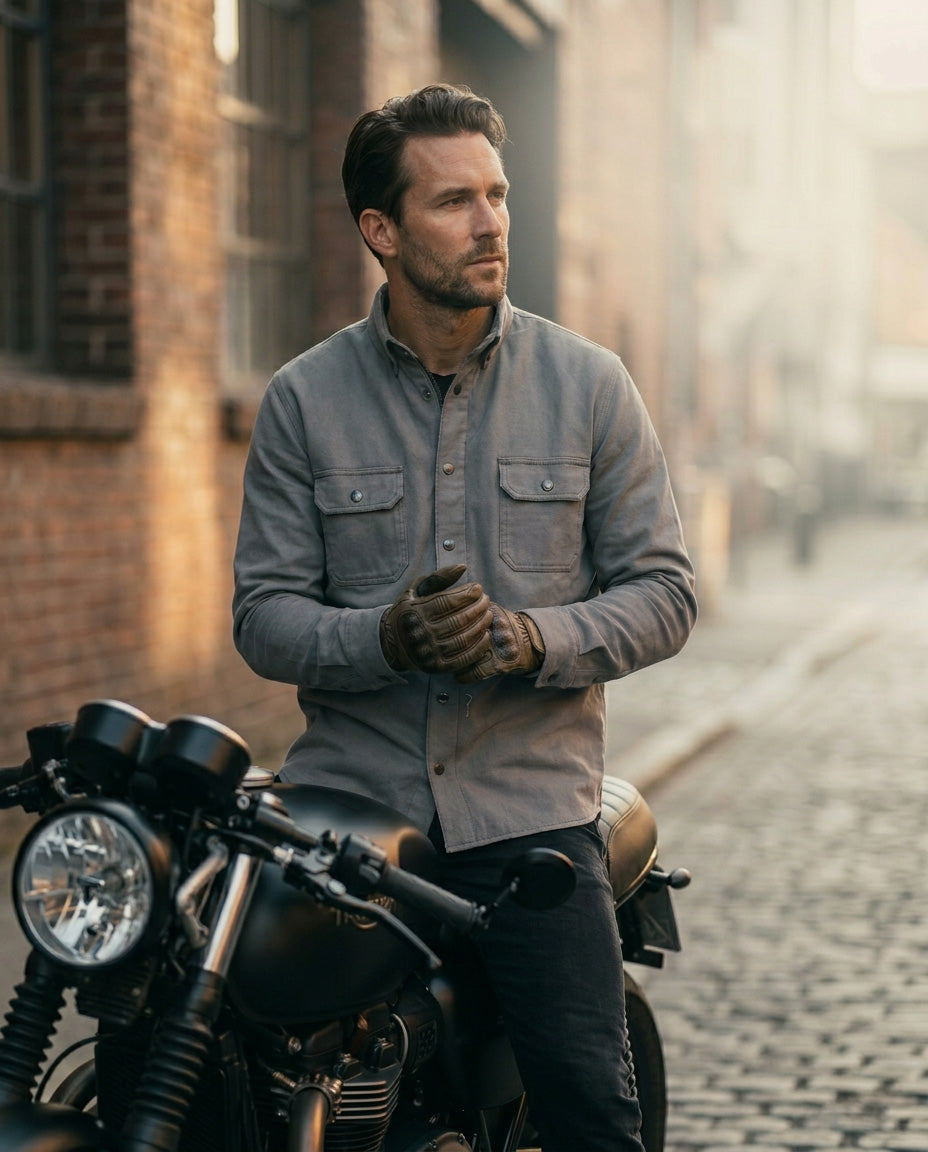
Motorcycle Shirts: Kevlar Flannel vs CE-Certified Riding Shirts
In short: A protective riding shirt is certified to EN 17092 as a complete garment, ideally class AA or AAA, with armor at shoulders and elbows. "Kevlar® flannel" or "armored shirt" alone is not a guarantee. The Kingston Motorcycle Shirt is single-layer PEKEV® Ultra Lite, certified to class AAA, with RE ZRO® Flat Level 2 armor.
The riding shirt has become one of the most popular pieces of motorcycle clothing, and it is easy to see why. It looks like a flannel or an overshirt, you can wear it to work or to the bar, and on the bike it replaces a jacket on warm days. But "Kevlar® flannel", "armored flannel" and "riding shirt" can mean very different things.
What is a motorcycle riding shirt?
A motorcycle shirt is a protective garment cut like an overshirt: buttons or snaps at the front, a collar, chest pockets. Inside, it has an abrasion-resistant layer and pockets for impact protectors at the shoulders and elbows. Worn over a T-shirt or a thin base layer, it is meant to be your outer layer on the bike.
Kevlar® flannel, armored shirt or CE-certified shirt?
- Armored shirt usually means the shirt has protectors. It says nothing about the fabric.
- Kevlar® flannel means there is aramid in the shirt, often as panels at the shoulders and elbows. The rest can be regular flannel.
- CE-certified to EN 17092 means the complete shirt was tested: fabric, seams, closures, fit and protectors. Class AA or AAA is what to look for if the shirt is your only layer on the bike. More in CE AA vs AAA: What EN 17092 Ratings Mean.
A shirt with a protective panel only at the shoulders leaves your back, sides and forearms in regular fabric. Coverage matters as much as the material.
Single-layer or lined?
Many riding shirts use a protective lining sewn into a regular shirt. That works, but it adds weight and warmth, and the lining can shift. In a single-layer shirt, the protective fiber is woven into the fabric itself. It moves like a normal shirt, breathes better and keeps its shape after washing.
The Kingston Motorcycle Shirt
The Kingston Motorcycle Shirt is our everyday riding shirt. It looks and moves like a favorite overshirt, and the protection is built into every thread.
- Fabric: PEKEV® Ultra Lite, single-layer and abrasion resistant, cotton-lined for comfort
- Certification: CE EN 17092, class AAA
- Armor: RE ZRO® Flat Level 2 at shoulders and elbows, plus a back protector pocket
- Fit: regular, relaxed through the shoulders and chest, with room for a base layer
- Colors: Charcoal, Coronet Blue, Fudge and Rhubarb Red
When is a riding shirt enough?
A certified riding shirt is a great choice for dry, mild to warm days, for commuting and for riding in town or on back roads. It is not a rain jacket and not a winter jacket. On cool mornings, layer a thin fleece or base layer under it. On wet days, add a rain shell over it.
How to choose the right size
- Choose by chest measurement. The Kingston runs from S (36–38") to 4XL (48–50"). See the size guide.
- Check the fit in the riding position: arms forward toward the bars. The sleeves should still reach your wrists, and the elbow protectors should sit on your elbows.
- Between sizes? Size up for riding comfort.
Frequently asked questions
Is a Kevlar flannel safe for motorcycle riding?
It depends on how much Kevlar® there is and where. Look for a CE EN 17092 class on the label rather than a material name. That tells you how the whole shirt performed in the test.
Can I wear a riding shirt instead of a jacket?
A riding shirt certified to class AA or AAA meets the same abrasion classes as many riding jackets. It just doesn't have weather protection. On dry, warm days it can replace a jacket.
Should I add a back protector?
Yes, if you can. The Kingston has a pocket for a back protector in size M or L.
How do I wash a motorcycle shirt?
Remove the protectors, wash on a gentle cycle at max. 86°F (30°C) and lay flat or hang to dry. With PEKEV®, the protection does not wash out.
The bottom line
The best riding shirt protects like a jacket and looks like a shirt. Look past "armored" and "Kevlar®" to the CE class, check how much of the shirt is actually protective, and make sure the armor sits where it should. Then wear it, on and off the bike.